
Enjoy the IOA Annual Colloquium? Donate: UW Foundation Donation
Annual Colloquium
Since 1988, the IOA has hosted an annual event known as the Institute on Aging Colloquium. It is free and open to the public, and now attracts a full-capacity crowd each year from the campus and community. Local researchers showcase cutting-edge science in diverse aspects of aging through talks and poster exhibits, while many organizations from the community provide a Health and Resource Fair. The program additionally includes a Keynote Address by an internationally recognized leader on current and critical topics of aging as well as presentation of New Investigator Awards to junior scholars.

A Successful 2026 Colloquium
Thank you to all who attended and supported our 36th IOA Annual Colloquium, held Oct. 14, 2026 in Madison, Wisconsin.
If you were unable to participate, see below for some of the resources that were offered at the event:
2026 Exhibitors showcased at our Health & Resource Fair
2026 Posters presented at our Poster Session
2026 Speakers and Talks (recordings will become available at a later date)
Gordon Dining & Event Center

770 W. Dayton St., Madison, WI 53706 (on the corner of W Dayton St and N Lake St, 3 blocks south of the campus end of State St.)
The first floor of Gordon is a public dining hall. The second floor is the event center, which has rooms reserved for the Colloquium.
Bike racks are available near the building if you are cycling to the event.
See the event location on the UW–Madison campus map
Get directions on Google Maps
Parking

Several public parking lots, both campus & city run, are available within 1-3 blocks of the event. All of them are self-pay. Parking is not onsite.
UW Campus Parking:
Contact UW Transportation Services for all Campus Parking questions: 608-263-6666.
To guarantee parking, we recommend purchasing a campus parking permit in advance (application due Friday, September 18th).
- If you have questions about a campus parking permit for which you have already applied, contact UW Transportation Services at customerservice@fpm.wisc.edu or call (608) 263-6666.
- UW–Madison Accessible Parking for Visitors.
- Some lots on the application form have EV charging stations for additional costs.
- View general information about visitor parking on campus.
- View real-time campus parking availability.
Other Public Parking:
Other nearby public parking ramps are available. These ramps are not managed by the university and cannot be reserved in advance.
- If campus parking is full, we recommend using the State Street Campus Garage (Entrance: 430 N. Frances St.), which has over 500 public parking spaces. The Lake Street entrance is temporarily closed during reconstruction of facility.
- View all public parking ramps managed by the city of Madison.
Buses:
The event is also easily accessible via city buses. See the City of Madison Metro guide.
2026 Annual Colloquium Speakers & Talks
The Social Genome: How Connection Shapes Healthy Aging
Steven W. Cole, PhD, UCLA
Human social genomics reveals how social connection, stress, purpose, and culture shape gene activity in ways that influence health and aging. This work also uncovers molecular roots of resilience, offering a biologically grounded view of what it means to thrive. In a dawning era of genomic self-awareness, this research reveals a powerful message: we can actively shape our own molecular well-being, offering new opportunities to promote health, vitality, and longevity.
Bridging Alzheimer’s Disease and Autism Research
Cara Westmark, PhD, UW–Madison
This talk will explore how discoveries in Alzheimer’s disease and autism research may benefit one another. Drawing from our work and others, I will examine how changes at the synapse—the tiny communication points between brain cells—shape both age-related neurodegeneration and early life neurodevelopmental disorders. I will discuss how proteins such as amyloid beta and fragile X messenger ribonucleoprotein (FMRP) influence brain function across the lifespan, and how factors like diet and nutrition may affect these pathways. By connecting Alzheimer’s and autism biology, this talk will highlight emerging evidence that may open new avenues for prevention and treatment.
Mindful Eco-Wellness: Steps towards Healthier Living for People and Planet
Bruce Barrett, MD, PhD, UW–Madison
An aspirational definition of “eco-wellness” has to do with living your life to achieve maximum health and happiness, while also supporting environmental sustainability and ecological integrity. An “eco-wellness behavior” is any choice, habit, or other behavior that contributes to both personal health (mental and/or physical) and environmental sustainability. We are now living in a time of multi-crises, with global warming, climate change, earth’s sixth mass extinction event, and increasing societal and international discord threatening both humanity and the ecological systems in which we live. By choosing and practicing eco-wellness behaviors, we can support the health of ourselves and our planet.
Supporting Wisconsin’s Caregiving Future: Resources, Tools, and Policies that Help
Beth Fields, PhD, OTR/L, BCG, UW–Madison
Family caregiving is critical to the health and well-being of older adults, yet many caregivers struggle to find the information, services, and tools they need. In this talk, Dr. Fields will describe Wisconsin’s caregiving landscape and the challenges families commonly face. She will share her team’s work to improve caregiver identification and develop assessment tools that enable more timely and appropriate support. She will also highlight key state and national policies shaping the future of care. Together, these insights show how timely resources can strengthen caregiver well-being and improve outcomes for older adults.
2026 Health & Resource Fair Exhibitors
Thank you to our sponsors:
Attic Angel Community: Attic Angel is a historic world of hometown philanthropy, care for community, and options for senior living.
Azura Memory Care and Assisted Living of Verona: Azura provides memory care and assisted living households designed to meet the needs of those living with memory loss.
BrightStar Care: Caregivers at BrightStar® Home Care Madison provide in-home care ranging from companionship, help with errands, and light housekeeping to personal care services like assistance with bathing, hygiene, and mobility.
Encompass Health Rehabilitation Hospital of Fitchburg: Physicians, nurses, therapists, and additional professionals provide inpatient rehabilitation care for stroke, brain injury, hip fracture, and other complex neurological and orthopedic conditions.
FOX Rehabilitation: Outpatient in-home physical, occupational, and speech therapists, and fitness specialists work with patients to help improve muscle function, coordination, endurance, and mobility.
LaDonna Steinert, Seniors Real Estate Specialist: Connects with a network of specialists across financial, legal, property, and personal services—from estate planning to downsizing—to assist with considerations in a sale and move.
Oak Park Place: A family of senior living communities offering independent living, assisted living, memory care, and rehabilitation options in Madison, Baraboo, Janesville, and more locations throughout Wisconsin, Iowa, and Minnesota. Offers a balance of independence and assistance, as needed.
Oakwood Village: A locally operated, faith-based non-profit continuing care community providing services on two campuses: Oakwood Village Prairie Ridge on Madison’s east side, and Oakwood Village University Woods on Madison’s west side.
SAIL (Sharing Active Independent Lives): A member-led, Dane County non-profit community that supports the independence of adults age 55+ by helping one another stay connected, active, and safe through activities, education, socializing, and access to resources.
Senior Helpers: Provides in-home personal care, companion care, transportation and outings. Case management services and nurse management services are also provided. Senior Helpers specialize in Parkinson’s, dementia care, and veteran care, and offer education services for community providers.
Transformation Center: A community-based fitness center focused on small group fitness classes, tailored for those over 50, with the goal of improving overall strength, balance, flexibility, and cardiovascular ability. Trainers and staff center on three pillars of fitness, wellness, and community.
Trilogy Health Services: Waunakee Valley Senior Living and Sun Prairie Senior Living are Rehab Care, Long-term Care, Memory Care, Assisted Living and Independent Living facilities.
Visiting Angels: Caregivers offer personalized assistance and in-home care services across numerous towns and communities in Wisconsin. Services include assistance with daily tasks, companionship, or specialized care.
2026 Poster Session
The Poster Session features posters on various aging-related topics dealing with psychosocial, biomedical, and clinical/applied research. Posters are presented by faculty, research scientists, postdocs, and students.
New Investigator Awards
Awards are given to UW–Madison students or advanced trainees to recognize outstanding achievement in aging or life course studies. Winners receive a $500 award and their research is showcased in the event’s Poster Session.
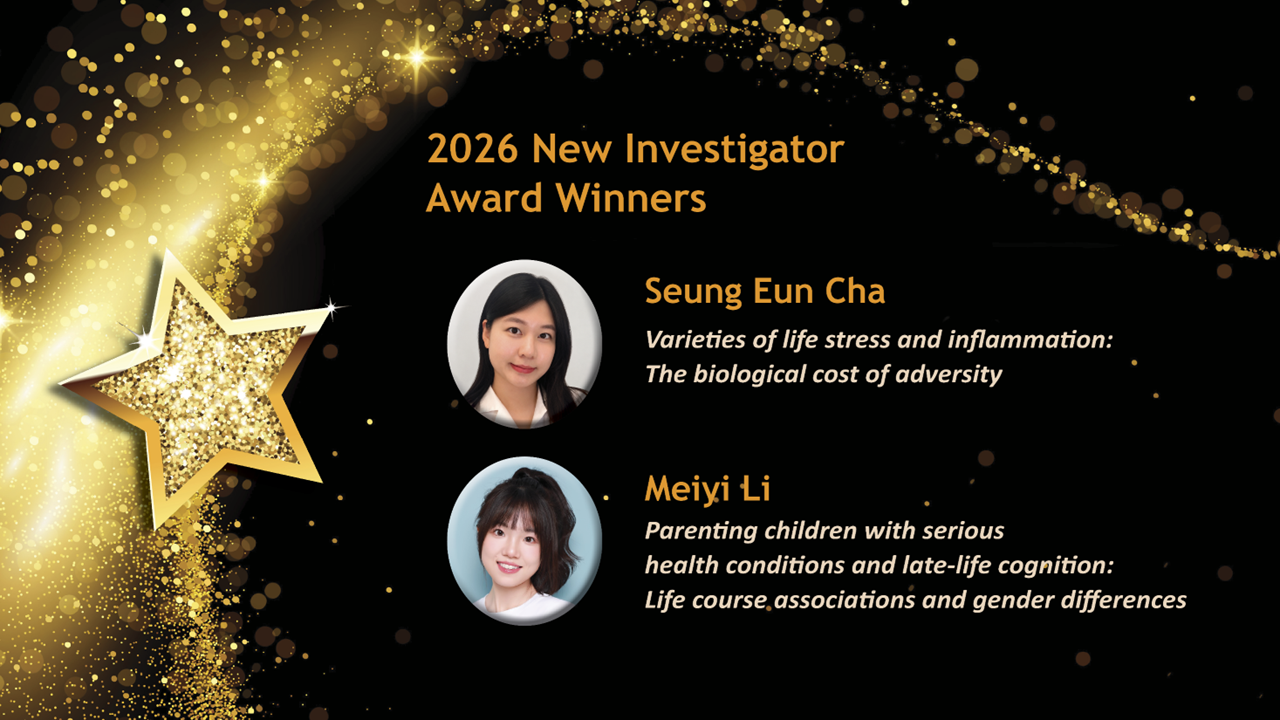
2026 New Investigator Award Winners:
Seung Eun Cha
Varieties of life stress and inflammation: The biological cost of adversity
Meiyi Li
Parenting children with serious health conditions and late-life cognition: Life course associations and gender differences
Keynote Talk Recordings
2025 Keynote Speaker: Carol Ryff, PhD
2024 Keynote Speaker: Marsha Mailick, PhD
Colloquium Archive
The following digital content is archived and not accessible. To request an accessible version or a reasonable accommodation due to disability, please email aging@ssc.wisc.edu.